
For 2023-24, the Gateway Information Technology and Society Course (INT200) will not be offered and its requirement will be waived for the IT&S Emphasis.
To complete the Ph.D. Emphasis in Information Technology and Society (iT&S), students already enrolled in participating UCSB departments must complete the following actions:
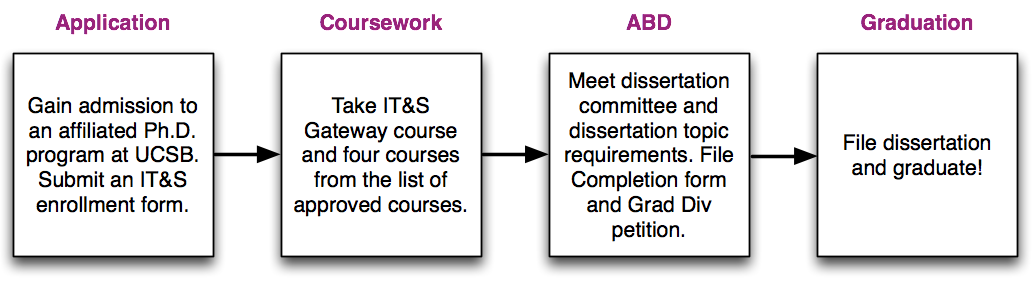
See below for detailed information about each stage: Application, Coursework, ABD, and Graduation.
Application
Application to the Information Technology & Society Optional Emphasis Program requires that you already be enrolled and in good standing in a Ph.D. program (or Masters-Ph.D. program) of one of the following participating departments at UCSB: Anthropology; Communication; Computer Science; English; Film and Media Studies; Geography; History; Linguistics; Media, Arts & Technology; Political Science; the Gevirtz Graduate School of Education; Global Studies; the Bren School of Environmental Science and Management; Psychological and Brain Sciences; Sociology; or the Technology Management Program.
To apply to participate in the iT&S emphasis, students must submit an Intent to Enroll Form, which asks them to state proposed coursework choices for completing the emphasis. See below in the Coursework section for courses that have been approved to apply toward the emphasis. Please note that this listing (and the Graduate Catalog listing for the Emphasis) are the only valid sources of courses that can be counted toward the Emphasis without an approved petition (other prior versions of CITS or iT&S websites or pages are invalid). Students wishing to apply a course toward the Emphasis that does not appear on the approved list of courses can submit a Course Petition Form, and should provide as much information as possible about the course. Submit all forms to the CITS office, 1310 SS&MS.
Students are not obligated to take the exact courses they list on their original Intent to Enroll form. Students can resubmit the Intent to Enroll to change their course plans on file.
If students would like advising about their course selection, they should contact the Director of the iT&S Ph.D. Emphasis to schedule a meeting.
Coursework
Coursework in the emphasis should develop a working familiarity with contrasting approaches to the study of technology and society. The curriculum requirement itself has two components: participation in an Information Technology and Society Colloquium (a.k.a. the “gateway seminar”) and completion of a set of graduate courses (see below), three of which must be outside the student’s home department
Gateway Information Technology and Society Course (INT 200) Requirement
An important part of the iT&S Emphasis experience is interacting directly with the cohort of other students in the program and developing an intellectual community beyond the student's own discipline. Toward this goal, students must complete a 1 or 2-unit gateway course titled "Information Technology and Society Colloquium." This course will meet approximately two hours per week, and will be taught by a member of the Information Technology & Society Emphasis faculty. This “gateway seminar” is usually taught once a year. The course focuses on interaction across disciplines and on exploring differences in conceptualization and approaches to knowledge-production across disciplines on topics that change each offering, based on the faculty member convening the seminar. Please note that the gateway seminar can be taken at any point in time during your program of study. Students are encouraged to take the Gateway seminar as many times as they like, since the subject and instructor changes each year.
Graduate Course Requirement
The course requirement has two goals: exposure to differing methodological and epistemological approaches to the study of information technology and society, and exposure to a range of substantive subject areas, independent of method and epistemology. This is why a total four elective courses are required to complete the emphasis, and why only one course from a student’s home department may count toward the emphasis.
It is important that students seeking a multi-disciplinary understanding of technology and society be exposed to inquiry from different perspectives. Therefore, the first consideration in our curriculum requirement is that the students' menu of courses be constructed in such a way as to encourage study of information technology and society from across the humanities, social sciences, and physical sciences. The second consideration in the curriculum is that the students’ coursework be organized around substantive breadth in at least two of these areas. The main substantive concerns for the emphasis involve breadth with respect to several topics.
Much of the disparate literature on information technology and society falls into one or more of two large categories: 1) study of cultures, meanings, and other human constructs; 2) study of human behavior, organizations, and social structures. The first of these topics tends to be emphasized by scholars working in humanistic traditions, although this is not exclusively the case, while the second tends to appear chiefly but not exclusively in the social sciences, as well as in education and some physical sciences (e.g., computer science, information science). Therefore the curriculum is organized to accomplish both these methodological-epistemological goals and substantive goals.
Students must complete four 4-unit approved courses with a grade of B or better, and only one course from a student’s home department can be counted for the emphasis. "Culture and History" courses explore the humanistic study of cultures, histories, and meanings as they intersect with technology. "Society and Behavior" courses investigate the social scientific study of technology in relationship to human behavior, organizations, and social structures. When instructors are listed parenthetically with a course, the course only counts toward the emphasis when that instructor is the instructor of record.
Currently Approved List of Emphasis Courses (4/2018)*
Culture and History
- ENGL 238 (Course title varies, approved for technology titles with Liu, Raley, and Warner)
- FAMST 231 Media Historiography
- FAMST 241 Television and New Media Theory
- FAMST 248 Digital Media Theory and Practices
- FMST 252MD Media and Datafication
- FAMST 255 Gaming Culture
- FAMST 264 Media Geographies
- FAMST 265 Race and Gender in Digital Culture
- FAMST 267 Media Industries
- GLOBL 222 Global Culture, Ideology, and Religion (Gunn)
- HIST 201HT Core Readings in History of Technology (McCray)
- HIST 201S Readings in the History of Science and/or Technology (McCray)
- MAT 200A Arts and Technology
- MAT 200B Music and Technology
- MAT 200C Digital Media Technology and Engineering
- MAT 255 Techniques, History & Aesthetics of the Computational Photographic Image (Legrady)
- MAT 259 Visualizing Information*
Society and Behavior
- COMM 213 Mass Media, The Individual, and Society (Metzger)
- COMM 214 Social Media (Flanagin)
- COMM 222 Organizational Communication
- Comm 594CM Computer Mediated Communication
- Comm 594MD Media Representation of Diversity
- CMPSC 284 Mobile Computing (Belding)
- ED 256 Technology and Learning Contexts (Harlow)
- ED 257A Teaching and Learning with Digital Media
- ESM 261 Management of Scientific Data (Frew)*
- ESM 263 Geographic Information System (Frew)*
- GEOG 231 Cognitive Issues in Geographic Information Science
- GEOG 258 Conceptual Modeling and Programming in GIScience (Janowicz)
- GLOBL 223 Global Governance, Human Rights, and Civil Society (Amar)
- GLOBL 253 Science, Technology and Globalization (Barandiarian)
- LING 205 Programming for Linguists*
- LING 208 Foundations of Computational Linguistics*
- LING 209 Advanced Computational Linguistics: Speech*
- LING 210 Computational Linguistics: Text Processing*
- POLS 237 Social Movements and Collective Action (Bruhn)
- POLS 267 Political Communication (Bimber)
- PSY 234 Computer Programming For Experimental Psychologists (Giesbrecht)*
- TMP 273 Technology Strategy
- TMP 274 Networks and Innovation
- TMP 275 Technology and Organizational Change
- TMP 276 Team Processes and Performance
- TMP 283 Ethnographic Research Methods*
- SOC 230 Sociology of Digital Technologies
*Method focused course
Note: This page, in its current form, is the only valid listing of pre-approved courses that count toward the Emphasis. New courses may be added to this list by consent of the Information Technology and Society faculty.
Students may also submit a Course Petition for the acceptance of another graduate course in substitution for one on the approved list. Some examples of courses that have been approved in the past include ESM 262, ESM 267, TMP 281, TMP 282, PSTAT 231, PSTAT 235. Course Petition forms are available on the forms page. Petitions must be reviewed and approved by the iT&S Faculty Executive Steering Committee. Submit petitions to the CITS office, 1310 SS&MS or via email to the CITS Director of Education.
Upcoming Classes
This is a tentative schedule of classes based on projected course offerings published by each department. This list may change and may not reflect all iT&S required courses that will be taught this year in every department, so please contact the relevant department to confirm if and when a specific required class that you are interested in taking is being offered.
| Fall 2023 |
| ENGL 238 (Raley) - Studies in Media, Technology and Information |
| MAT 200C (Yerkes) - Multimedia Technology and Engineering |
| MAT 255 (Legrady) - Techniques, History & Aesthetics of the Computational Photographic Image |
| COMM 214 (Flanagin) - Social Media |
| GLOBL 223 (Amar) - Global Governance, Human Rights, and Civil Society |
ABD
The Information Technology & Society Ph.D. Emphasis requires a dissertation topic relating in some way to issues surrounding information technology and society. During the ABD phase, a student must form his or her dissertation committee containing at least one CITS affiliated faculty member (click here for a list of affiliated faculty).
Upon defending the dissertation, students should submit a Completion Form (available here), notifying the iT&S Ph.D. Emphasis Director of completion of the emphasis requirements. Once the director has reviewed and approved the form, they will certify to Graduate Division that the student has completed the requirements for the Ph.D. Emphasis.
At that time, the student should also submit the Graduate Division Petition (available from the UCSB Graduate Division) to add the emphasis if s/he has not already done so. This petition will require signatures of the student’s departmental Graduate Advisor, the faculty director of the Information Technology & Society Ph.D. Emphasis, and the Graduate Division, and there will be a nominal fee upon submission. All forms are available here. Submit the Completion Form to the CITS office, 1310 SS&MS. Submit Graduate Division Petition to CITS for iT&S Director signature, then submit it to the Graduate Division.
Graduation
If the student has not done so already, s/he should submit a Completion Form to the iT&S Emphasis Director and the Graduate Division Petition (see ABD Phase) to the UCSB Graduate Division. If all forms are submitted and approved, then the student should simply file the dissertation and graduate!